
War, Trust and Precious Metals | Part I
Before It Was a Safe Haven: How Gold Became Money
Long before gold became an investment product, it became a way to carry trust across distance, generations and political change.
By Saruhan Efe Saruhanoglu||9 min read
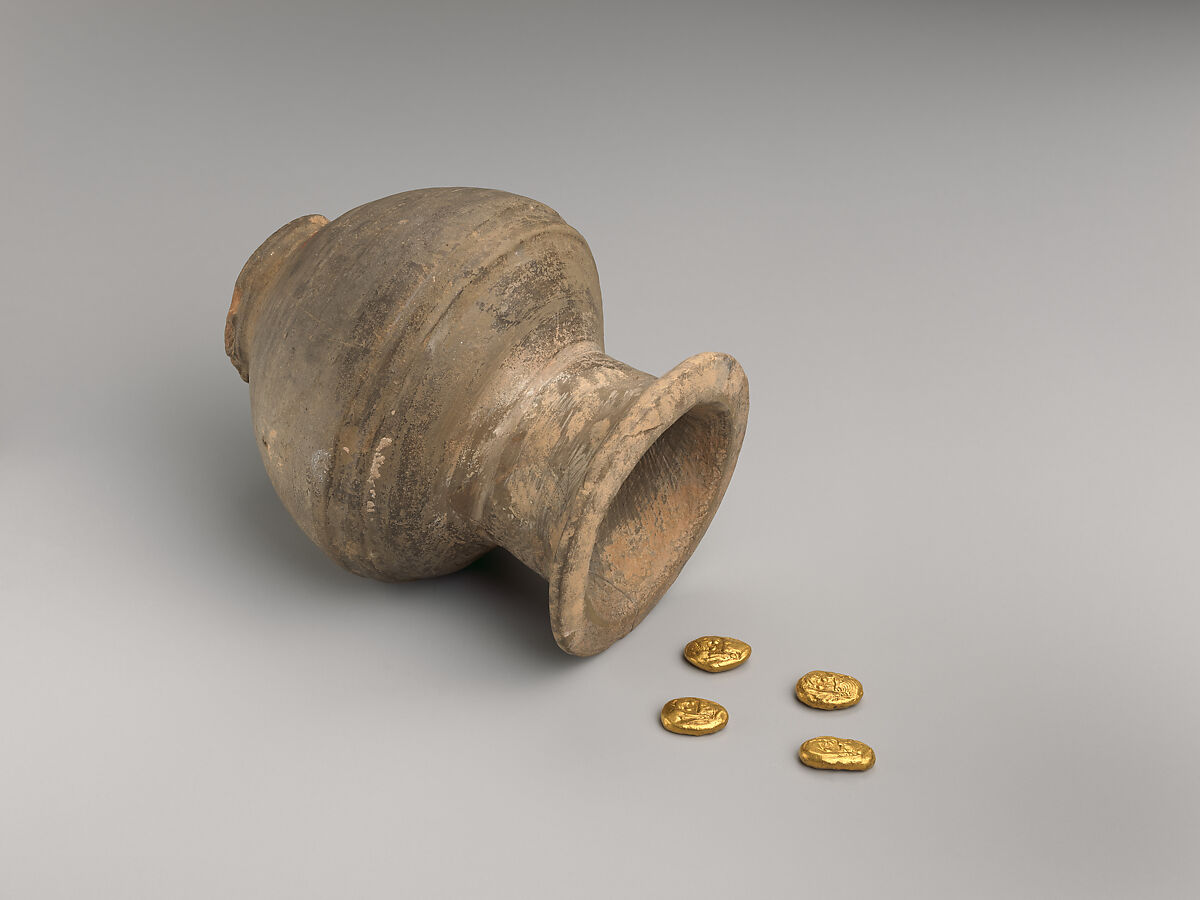
At some point around 547 BCE, while Persian forces were closing in on Sardis, someone placed thirty gold staters inside a small terracotta jar and buried it.
We know the jar. We know the coins. We do not know the person.
Perhaps the money belonged to a merchant who expected to return when the fighting was over. Perhaps it was a family reserve, an escape fund or the accumulated savings of a lifetime. Whatever the story, the owner seems not to have come back for it. The Metropolitan Museum of Art dates the jar to the reign of Croesus and believes it was hidden for safekeeping shortly before the Persian conquest of Sardis. 1
There are few cleaner images of what gold has meant in uncertain times. Those coins were not buried because they promised a yield. They were buried because they concentrated trust in something small enough to hide, durable enough to wait and recognisable enough to matter after power changed hands.
Before Gold Had a Price, It Had Meaning
Modern markets tend to meet gold at the end of its story, as a price on a screen. Earlier societies often met it first as light, ritual and authority.
In parts of the ancient Americas, gold was closely associated with the sun and the sacred. It appeared in regalia, offerings and objects designed to project rank. Its resistance to decay made it a natural symbol of endurance and power. Yet the attraction was not universal. The same historical record shows that some societies placed greater value on jade, feathers, textiles or shells. 5
That nuance is important. Gold did not become valuable because humanity discovered a single, objective truth hidden inside the metal. Value was built through use, memory, belief and repeated acceptance. Gold was unusually well suited to that process, but people still had to choose it.
Its economic career therefore began before economics had a name. Gold was worn, offered, inherited and displayed long before it became a formal unit of account. By the time rulers began stamping it into coin, the metal already carried a language of rarity and permanence that people understood.
Why Gold Was Different
Gold has a physical presence that feels almost designed for memory. It is heavy in the hand, unmistakable in colour and slow to surrender to time.
The United States Geological Survey notes that gold was among the first metals to be mined because it often occurs in its native form, is workable and was prized for its beauty and permanence. The Royal Society of Chemistry describes a metal soft enough to be shaped and beaten into extremely thin sheets, yet chemically resistant enough to survive where many other materials corrode. 34
Those qualities solved several practical problems at once. Gold was scarce enough to carry significance, but available enough to enter trade. It could be divided, melted and remade without destroying the material itself. A ceremonial object could become a bar; a bar could become a coin; a coin could become jewellery. The form changed, while the underlying metal remained.
Its density also allowed a considerable amount of value to be carried in a relatively small space. That mattered to merchants crossing long distances, to rulers moving treasury wealth and, in darker moments, to families trying to preserve something they could take with them.
Silver often performed more of the daily work of money because its lower value per unit of weight made it practical for smaller transactions. Gold was better suited to large payments, reserves and concentrated wealth. For long periods, monetary life depended not on one precious metal but on a relationship between the two.
Physical advantages alone, however, do not create money. A durable stone is still only a stone unless a community agrees to accept it. Gold needed a social network around it: miners, refiners, assayers, merchants, rulers and, eventually, mints.
How Gold Became Money
The decisive change took place in Lydia, in western Anatolia. The exact chronology is still debated, but electrum coins, made from a naturally occurring alloy of gold and silver, appear to have entered use near the end of the seventh century BCE. Herodotus later credited the Lydians with inventing coinage, while King Croesus, who ruled from around 560 to 546 BCE, became associated with the issue of separate gold and silver coins. 2
The breakthrough was not simply the idea of exchanging precious metal. People had weighed and traded metal long before the first coin. The breakthrough was the stamp.
A recognised mark allowed an issuing authority to make a public claim about weight, fineness and denomination. The buyer no longer had to begin every transaction from zero. A coin compressed a chain of work into a small object: extraction, refining, weighing, testing and official recognition.
Gold did not eliminate the need for trust. It changed where trust lived.
A private exchange between two people became part of a larger system. The coin asked the holder to trust the mint, the ruler, the assay and the expectation that someone else would recognise the same mark tomorrow. The principle survives in modern bullion markets, where provenance, refining standards and custody still affect how easily metal can move from one owner or jurisdiction to another.
A Coin Was Never Just Metal
Once gold entered official coinage, every coin carried two kinds of value at the same time. One came from the metal it contained. The other came from the authority that defined the coin, accepted it in payment and placed its mark on the surface.
When those two forms of value supported each other, coinage could travel with unusual confidence. When they drifted apart, markets noticed. A ruler could reduce the precious metal content of a coin while preserving its face value. Merchants could discount an unfamiliar issue, prefer an older coin with a trusted fineness or melt different coins back into bullion.
This is one of the oldest tensions in monetary history. The state says what money is. The market decides how much confidence to place in that statement.
Gold made that tension visible because the promise was embodied in a measurable material. A coin could be weighed, cut, tested and compared. Official value was never entirely separate from physical evidence.
Gold Could Travel Where Politics Could Not
Gold was especially useful when trade crossed political and cultural boundaries. A merchant might not understand a foreign legal system or trust a distant ruler, but weight and fineness could be tested.
The trans-Saharan gold trade shows the scale of this advantage. From the seventh to the eleventh century, routes across the Sahara linked Mediterranean economies that demanded gold for coinage with West African regions where the metal was abundant. Gold and salt moved through commercial networks that joined very different societies. In the fourteenth century, the arrival of Mansa Musa in Cairo with an extraordinary quantity of gold was remembered precisely because it disturbed the local market. 6
The metal did not erase borders. It did something more practical: it remained translatable across them.
A foreign coin could be accepted as issued, valued by weight, discounted for uncertainty or melted and given a new form. The ruler stamped on its face might be local, but the material could outlive the ruler and continue its journey.
The Private Life of Gold
The history of gold is often told through kings, empires and central banks. Much of its meaning, however, has always lived at household level.
Across many cultures, gold has been given at weddings, passed between generations and kept as a family reserve. An item of jewellery can be adornment, memory and emergency wealth at the same time. Financial models prefer clean categories. Human lives rarely provide them.
This is one reason gold has remained emotionally durable even where it is no longer used for daily payment. A bank balance is abstract. A bond is a legal claim. A piece of gold can be held, worn and recognised without an interface.
Its ability to change form deepens that attachment. The same metal can pass through different generations in different shapes. What belonged to one person as a coin may belong to another as a ring, while retaining a material connection to the past.
That continuity is not perfectly measurable, but it is part of the reason gold has survived repeated changes in monetary technology. People do not value it only for what it can buy. They also value what it can carry: memory, status, identity and the sense that something has endured.
What War Reveals About Wealth
In stable periods, an asset can look like little more than a price. Conflict exposes the infrastructure underneath that price.
Can the asset be carried? Can ownership be proved? Can it be exchanged somewhere else? Does its value depend on one bank, one government, one network or one functioning border? Can the owner reach it when it is needed?
Gold has answered some of these questions better than many assets at different moments in history. It is compact, durable and widely recognised. It does not require a company to remain profitable or a debtor to make a payment. Yet none of this makes it immune to reality.
Gold can be stolen, confiscated, lost or left behind. Local markets can close. The difference between a quoted price and an executable price can widen. Bars require authentication; jewellery varies in purity; transport and storage introduce their own risks.
The Sardis jar is therefore a warning as much as it is a symbol. The metal survived. We cannot say the same about the owner, the plan or the life that surrounded it. Gold can preserve material continuity. It cannot promise personal safety, political stability or access.
That distinction matters whenever precious metals are discussed in the language of fear. Gold is not a solution to war. It is one of the assets through which people have tried to carry value across the damage war can do to institutions.
From Sacred Metal to Monetary Memory
Gold became money not because it was perfect, but because three different forms of trust met in the same material.
Nature provided durability, scarcity and recognisability. Society supplied meaning and acceptance. Institutions added standards, denominations and official authority. Remove any one of those elements and the story becomes weaker.
At every stage, gold performed two jobs. It was a physical object with measurable properties, and it was a symbol of something larger: divine favour, royal power, commercial credibility, family security or monetary discipline.
That double life explains why gold did not disappear when coins gave way to banknotes, or when banknotes lost their formal link to metal. Even today, a price quoted in a modern currency carries the memory of an older question: what can hold value when the rules around value begin to change?
Part II of this series follows that question from circulating coin to the gold standard, Bretton Woods and the balance sheets of modern central banks.
Next in the series
From Coin to Reserve Asset: How Gold Shaped the Architecture of Money
Part II.
Sources and Editorial Notes
Historical dates and interpretations were checked against the institutional sources below. The article uses BCE/CE dating and treats the Lydian origin of coinage as the widely accepted account while acknowledging continuing scholarly debate over exact chronology and attribution.
The Metropolitan Museum of Art. Terracotta jar, Lydian, ca. 560-546 BCE
The Metropolitan Museum of Art. Sardis
U.S. Geological Survey. Gold
Royal Society of Chemistry. Gold: element information, properties and uses
The Metropolitan Museum of Art. Gold in the Ancient Americas
The Metropolitan Museum of Art. The Trans-Saharan Gold Trade (7th-14th Century)
This article is provided for general informational and educational purposes only. It does not constitute investment, financial, legal or trading advice.