
War, Trust and Precious Metals | Part II
From Coin to Reserve Asset: How Gold Shaped the Architecture of Money
Gold once passed from hand to hand. It later stood behind banknotes, exchange rates and the international monetary system. Today it no longer defines official money, yet it remains on the balance sheets of central banks.
By Saruhan Efe Saruhanoglu||14 min read
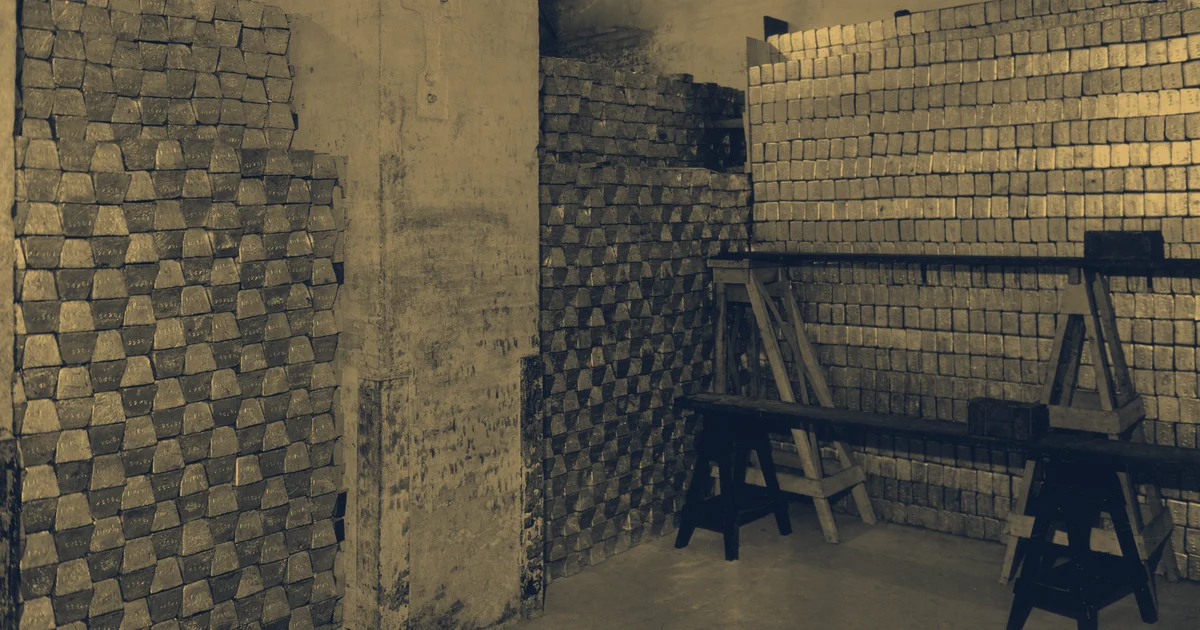
In 1797, during a war between Britain and France, news of a surprise French attack triggered a financial panic. Holders of Bank of England notes rushed to exchange paper for gold. The government responded by suspending convertibility. For the first time, the Bank issued low-denomination one- and two-pound notes to ease the shortage of coin.1
The military episode was brief. The monetary lesson was not.
A banknote can be beautifully engraved, legally recognised and accepted by millions of people, but it is still a promise. In a convertible system, that promise says the paper can be turned into metal. The moment people doubt that the promise can be honoured, the metal behind the note stops looking like a technical detail and becomes the centre of the system.
This was the paradox that followed gold into the modern age. It could make paper money more credible, yet the demand to redeem paper for gold could also expose the limits of that credibility. Gold was both the foundation of the promise and the asset people reached for when they feared the promise might fail.
When a Coin Became an International Instrument
The modern British Sovereign was introduced in 1817, after the Napoleonic Wars, as part of a wider reform of the currency. It carried a face value of one pound and a defined quantity of gold. Over the nineteenth century it became trusted far beyond Britain, moving through trade routes and commercial centres as a coin whose weight and fineness were widely understood.2
The Sovereign was successful because it made a complex system feel simple. A merchant could hold one coin in the hand and see a denomination, an issuer and a familiar design. What remained invisible was everything required to make that confidence possible: mines, refineries, assay offices, mints, banks, shipping routes, insurers, laws and a market willing to accept the coin again.
A trusted gold coin was never merely a piece of metal. It was a compressed institution.
Its value came partly from the gold it contained and partly from the reputation of the authority that had placed its mark upon it. Those two forms of confidence could reinforce each other. The state guaranteed the specification; the metal limited how far the state could redefine the object without the market noticing.
This was one of gold's great monetary strengths. It could be official without being entirely dependent on official language. A coin might lose favour, cross a border or outlive the ruler shown on its face, yet the underlying material could still be weighed, tested and remade.
What the Gold Standard Asked a Government to Promise
The classical gold standard extended the logic of the coin to the currency itself. A national monetary unit was defined in relation to a fixed quantity of gold, and the authorities committed to maintaining convertibility at that parity.
The arrangement gave exchange rates an anchor. When two currencies were each tied to gold, their relationship to one another became more predictable. This supported an expanding world of trade, investment and cross-border credit.
But the gold standard was not a warehouse in which every note waited beside an equal amount of metal. Banks still created credit. Governments still borrowed. Deposits and financial claims grew far beyond the coins in ordinary circulation. What sustained the system was the belief that conversion would remain available when required and that the official parity would be defended.
That belief imposed discipline, but it also imposed a cost. If confidence weakened, holders of paper claims could ask for gold. If the outflow became large enough, a central bank had to raise interest rates, contract credit, obtain additional reserves or suspend the promise. Adjustment could mean falling prices, weaker activity and unemployment. The metal did not make those choices. It made them harder to postpone.
A gold standard therefore did not remove politics from money. It placed politics around a fixed commitment and forced governments to decide how much economic pain they were willing to accept in order to preserve it.
War Changes the Meaning of Convertibility
Peace allows a monetary promise to be discussed as a principle. War turns it into a practical question.
A government at war must pay soldiers, purchase materials, secure energy and transport, support allies, manage shortages and sustain the domestic economy. Tax revenue rarely arrives at the same speed as wartime expenditure. Borrowing grows. The demand for liquidity expands. The state's need for financial room can collide with the obligation to convert monetary claims into a finite reserve asset.
Britain suspended the gold standard at the outbreak of the First World War in 1914. In 1925, it attempted to restore the pre-war parity through a system under which sterling could again be exchanged for gold bullion at a fixed price. The return was meant to signal that the old monetary order had survived. In practice, it placed a heavy burden on an economy that had been transformed by war.3
The commitment lasted six years. In September 1931, after confidence in sterling collapsed and reserves came under pressure, Britain left gold again.4
The sequence matters more than the dates alone. Suspension, restoration and abandonment showed that convertibility was not a natural condition of money. It was a policy choice, maintained only while the political authority believed the costs of defending it were lower than the costs of leaving it.
Gold had not failed to be gold. The promise built around it had become too expensive to keep.
Bretton Woods Put the Dollar Between Gold and the World
After the Second World War, policymakers did not simply rebuild the nineteenth-century system. They designed a more managed arrangement.
Under Bretton Woods, participating countries fixed their currencies to the US dollar, while the United States committed to convert official foreign dollar holdings into gold at US$35 per ounce. Gold remained the ultimate reference point, but most currencies now reached it through the dollar.
This gave the United States a unique role. The world needed dollars for trade, reserves and reconstruction, yet the larger the stock of dollars held abroad became, the harder it was to maintain confidence that all official claims could be converted into US gold at the fixed price.
The system contained a contradiction. International commerce required an expanding supply of dollar liquidity. Confidence in the gold link required restraint.
On 15 August 1971, the United States suspended the convertibility of the dollar into gold. The decision closed what became known as the gold window and effectively ended the Bretton Woods system of fixed exchange rates.5
A link that had survived in altered forms for generations was broken in a televised announcement. Money did not disappear the next morning. Salaries were paid, contracts remained valid and markets continued to function. What changed was the source of the anchor.
The leading currencies would henceforth rest more openly on the credibility of institutions, the productive capacity of economies, the authority to tax, the quality of law and the conduct of monetary policy.
Gold After Gold-Backed Money
The end of formal convertibility did not end gold's monetary life. It changed it.
Without an official dollar price, gold could respond more directly to inflation expectations, interest rates, currency movements, investment flows, jewellery demand, central bank decisions and political risk. It became a market price rather than a fixed monetary promise.
Gold also began to occupy several worlds at once. It remained a cultural and consumer asset in jewellery. It served specialised technological uses. It became accessible through bars, coins, exchange-traded products and derivatives. Most importantly for the monetary system, it remained in official reserves.
That persistence is easy to underestimate. Gold no longer defines the unit in which wages, taxes or debts are normally paid. It does not sit behind each banknote as a right of redemption. Yet institutions responsible for modern fiat currencies continue to hold it.
Gold left the centre of the system without leaving the room.
Is Gold Still Money?
Money is usually described through three functions. It acts as a medium of exchange, a unit of account and a store of value.
Gold still performs the third function for many households, investors and institutions. It performs the first two far less often. Shops do not usually price goods in ounces. Companies do not generally prepare their accounts in gold. Central banks set policy through national currencies, not by changing the metallic content of coins.
Calling gold a modern currency can therefore create more confusion than clarity. It is more accurate to describe it as a monetary asset or reserve asset: something that remains close to the idea of money without operating as everyday money.
The distinction becomes especially important when gold is compared with the US dollar.
The dollar is not dominant merely because central banks hold it. It is embedded in international payments, foreign-exchange trading, cross-border lending and debt markets. Federal Reserve research notes that the dollar was on one side of about 88% of global foreign-exchange transactions in the Bank for International Settlements' 2022 survey.6 That network cannot be replaced by moving bars from one vault to another.
Gold solves a different problem. It offers an asset with no issuing government and no contractual promise of repayment. The dollar provides extraordinary financial connectivity. Gold provides a form of separation from the credit of a particular issuer.
A reserve system can value both for different reasons.
The Modern Reserve Picture
The latest reserve data require careful reading because gold and currencies are often measured using different denominators.
In the first quarter of 2026, the US dollar represented 57.13% of disclosed global foreign-exchange reserves. The euro accounted for 20.03%, while the Chinese renminbi represented 1.99%.7 These figures describe the currency composition of foreign-exchange reserves; they do not include gold as though it were another currency in the same table.
Separately, the European Central Bank reported that gold became the world's second-largest reserve asset at market prices in 2024, behind the US dollar. The finding reflected both the stock of official gold and the sharp increase in its market value.8
The two statements are not contradictory. The dollar remains the leading reserve currency. Gold has become a larger component of total official reserve assets. One describes the architecture of currencies; the other describes the changing value of the assets held alongside them.
Price effects matter. In 2025, gold surpassed US Treasuries as a share of official reserves, but the IMF noted that the change was driven almost entirely by gold price valuation rather than by a sudden wholesale reallocation.7 A central bank can appear to hold a larger gold share even without buying another bar.
That is why reserve figures should be read as a mixture of active decisions and market movements.
Why Central Banks Continue to Hold Gold
Central banks purchased an estimated 863.3 tonnes of gold in 2025. That was lower than the exceptional level of 2024, but still historically elevated. Total gold demand, including over-the-counter activity, exceeded 5,000 tonnes for the first time, with an estimated value of US$555 billion.9
The official-sector interest is not based on nostalgia for gold coins. Reserve managers cite diversification, long-term value preservation, performance during crises, inflation concerns and geopolitical risk.
The World Gold Council's 2026 survey of 76 central banks found that 89% expected global official gold holdings to increase over the following twelve months. A record 45% expected their own institution's holdings to rise, while 74% anticipated a moderately or significantly lower global dollar share over the following five years.10
Those are expectations, not promises. They nevertheless show that the debate is active inside the institutions that issue and manage modern currency.
There is also a practical dimension. Gold held in an appropriate location can provide access to a deep market. The Bank of England, for example, holds around 400,000 bars in custody and describes its role as giving central banks secure storage and access to London market liquidity.11 The location of the metal, the legal title to it and the ability to mobilise it are part of its reserve value.
A bar is not useful merely because it exists. It must be owned clearly, trusted by the market and accessible when needed.
A Reserve Asset Is Not a Magic Asset
The renewed official interest in gold should not be mistaken for proof that it is risk-free.
A 2026 IMF note offered an unusually direct warning. It described gold as having no credit risk and potential long-term balance-sheet value, but also as highly volatile, only conditionally useful for hedging and poorly suited to the liquidity tranche of reserves. The note advised central banks to apply market-risk haircuts and to avoid treating price-driven valuation gains as a permanent improvement in reserve adequacy.12
This is an important correction to the language of safety.
Gold has no default risk in the way a bond issuer does, but it has price risk. It does not mature at par. It does not produce a contractual cash flow. Selling a large position quickly may carry market costs. Physical holdings require custody, insurance, audit and operational expertise.
An asset can be free of one kind of risk and still carry several others.
The same caution applies to claims that central bank buying represents the imminent end of the dollar system. Federal Reserve research published in 2025 found that, for most countries, gold accumulation was more consistent with modest diversification than with broad de-dollarisation. In many cases, institutions added gold without making it a substitute for the dollar's roles in settlement, funding and reserves.13
Diversification is not the same as abandonment.
What It Means to Own Gold
For private investors as well as institutions, the phrase "owning gold" can conceal very different legal and operational realities.
A bar held directly gives physical ownership, but it introduces questions of purity, provenance, storage, insurance and resale. Allocated vaulted gold may identify specific metal for the owner, yet the agreement, jurisdiction, audit process and withdrawal terms still matter. An exchange-traded product can provide liquid price exposure, but ownership is expressed through a security and its fund structure. Futures and other derivatives create contractual exposure, often with leverage, margin and expiry. Shares in a mining company add operational, geological, political and management risk to the movement of the metal price.
These positions may respond to the same headline gold price without being the same asset.
In calm markets, the distinctions can appear academic. Under stress, they become concrete. A quoted price is not identical to immediate access. A claim on metal is not always the same as title to a particular bar. A liquid security in one jurisdiction may not solve a custody problem in another.
The history of money repeatedly returns to this gap between value in principle and value that can actually be used.
Monetary Memory
Gold no longer sits at a fixed point beneath the world's major currencies. It cannot be presented at a central bank counter in exchange for the official value printed on a note. It does not determine the amount of credit an economy may create.
Yet it remains on central bank balance sheets because it represents something that modern money cannot fully reproduce: an asset without a national issuer, with a market older than the institutions that hold it.
Its role today is neither a return to the nineteenth century nor a rejection of fiat currency. Gold and modern money coexist because they carry different forms of trust.
Currency asks whether an institution will preserve purchasing power, honour contracts and keep the payment system functioning. Gold asks whether value can be held in a material that does not depend on that institution's promise.
The answer to one question does not cancel the other.
That is why gold's journey from coin to reserve asset is not a story of disappearance. It is a story of relocation. The metal moved from pockets to vaults, from the face of money to the edge of the system, where it continues to measure how much confidence the system commands.
Part III turns from monetary architecture to the moment that architecture comes under pressure: war, sanctions, political fracture and the difficult question of what a safe haven actually is.
Previous in the series
Before It Was a Safe Haven: How Gold Became Money
Coming next
When Trust Fractures: How Precious Metals Behave in War and Geopolitical Conflict
Part III. Coming soon.
Sources and Editorial Notes
Historical milestones and current reserve data were checked against central bank, monetary authority and specialist market sources. Foreign-exchange reserve shares and gold reserve-asset estimates use different denominators and are therefore explained separately rather than presented as directly comparable figures. Market figures reflect the most recent data available at the time of writing.
Bank of England Museum. Inimitable Notes: The Quest for the Perfect Banknote
Royal Mint Museum. Modern Sovereign
Bank of England. The Exchange Equalisation Account: Its Origins and Development
Bank of England. History
International Monetary Fund. From the History Books: The Rethinking of the International Monetary System
Board of Governors of the Federal Reserve System. The International Role of the U.S. Dollar, 2025 Edition
International Monetary Fund. IMF Data Brief: Currency Composition of Official Foreign Exchange Reserves, Q1 2026
European Central Bank. Gold Demand: The Role of the Official Sector and Geopolitics
World Gold Council. Gold Demand Trends: Q4 and Full Year 2025
World Gold Council. Central Bank Gold Reserves Survey 2026
Bank of England. Gold
International Monetary Fund. Gold in Central Bank Reserves: Strategic Considerations, Market Risks, and Practical Guidance
Board of Governors of the Federal Reserve System. De-Dollarization? Diversification? Exploring Central Bank Gold Purchases and the Dollar's Role in International Reserves
Disclaimer: This article is provided for general informational and educational purposes only. It does not constitute investment, financial, legal or trading advice, and it should not be relied upon as a recommendation to buy, sell or hold any asset.